








Newsletter Subscribe
Enter your email address below and subscribe to our newsletter

Enter your email address below and subscribe to our newsletter
Relive the Classics, One Pixel at a Time
 ByStorkath
Just when you thought it was safe to put down the joystick, just when you believed you had finally managed to fend off the legions of digital villains that software houses
| Released | Genre | Publisher |
| 1987 on DOS | Action | Infogrames |
Just when you thought it was safe to put down the joystick, just when you believed you had finally managed to fend off the legions of digital villains that software houses have been throwing at us for years, a new challenge emerges from the shadows. The industry never sleeps, and neither do the bad guys. This time, it is the renowned French developer Infogrames that has stepped into the ring to test our reflexes and our patience. Their weapon of choice? Prohibition.
For those frequenting the smoky, neon-lit arcades, this title will likely ring a bell. It is a game that we first encountered in the realm of the “coin-guzzlers”—those unforgiving arcade cabinets designed to devour our allowances one ten-drachma coin at a time. Now, however, the experience has migrated from the arcade hall to the living room. Prohibition has made the jump to home micros, bringing all its frantic energy and high stakes to your personal computer screen.
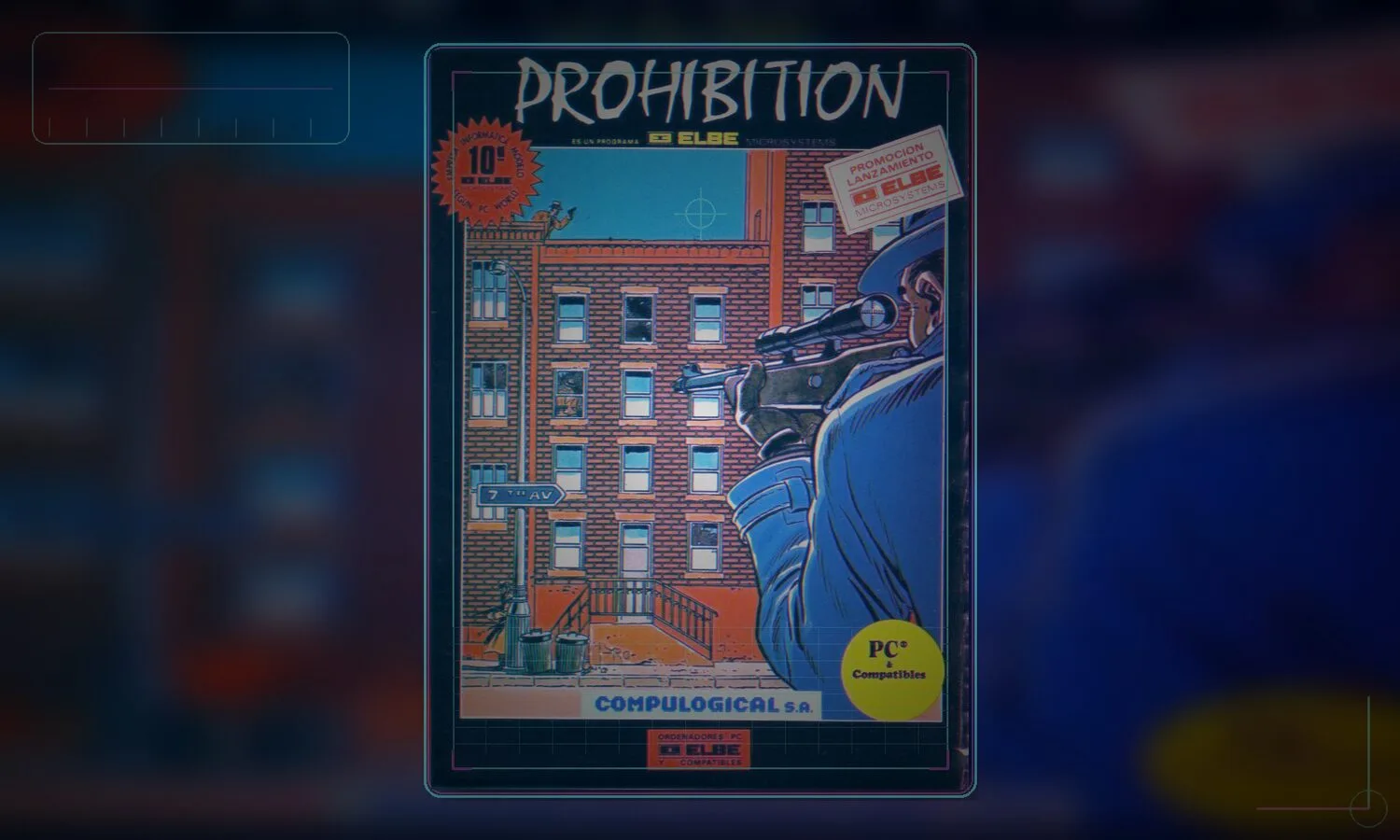
Once you navigate through the preliminary logistical hurdles—booting up the machine, dealing with the loading screens, and selecting your display options—you are immediately served the game’s “main course.” The setting is instantly recognizable: we are transported back to the roaring days of Prohibition-era America. It is a time of bootleggers, tommy guns, and lawlessness.
From the moment the game begins, it becomes abundantly clear that your interests do not align with the local populace. In fact, you seem to be the most hated person in the city. There is no other logical explanation for the sheer volume of hostility directed your way. Every towering skyscraper and tenement building that fills your screen seems to be infested with enemies.
To say you are outnumbered is a gross understatement. As you gaze upon the urban landscape, it feels as though there are seven or eight thousand thugs waiting specifically for you. Perhaps that is a slight exaggeration, but in the heat of the moment, with danger lurking behind every pane of glass, it certainly feels that way. These aren’t just bystanders; they are armed, dangerous, and ready to turn you into a statistic.
The premise of the game strips away any pretense of diplomacy. The only way to deal with this hostile army is through brute force. The reviewer notes that they tried to reason with the bad guys, perhaps talk it out over a coffee, but the opposition wasn’t interested in hearing a single word. Therefore, the only language left to speak is that of high-velocity lead.
You are armed with a pistol, and in a merciful concession to arcade-style play, the developers have granted you an infinite supply of ammunition. You never have to worry about reloading or running dry; you only have to worry about staying alive. The game forces you to adopt the ancient “Law of the Jungle”: it is either them or you. It’s a kill-or-be-killed scenario in its purest form.
However, the act of shooting an enemy is actually the easy part. The mechanics of aiming and firing are straightforward. The true difficulty—and the genius of the game design—lies in locating the threat. The screen is a dense tapestry of windows, balconies, and street corners. The enemies pop out one by one, emerging from random windows or stepping out of dark alleyways in the massive apartment complexes that dominate the background.
Here is where the “malice” of the programming team truly shines through. They haven’t just created a shooting gallery; they have created a high-pressure time trial. Once an enemy reveals themselves, a mental countdown begins. You have a window of approximately five to six seconds to spot them, move your crosshair, and fire.
If you fail to neutralize the target within that tight timeframe, the enemy begins to tremble. This animation isn’t out of fear; it’s the precursor to your doom. In a moment of lethal “clumsiness,” the enemy will pull their trigger. The result of this interaction is depressingly consistent. While you might miss your shot, the computer never does. If the enemy fires, they hit. You are the only one capable of making a mistake in this duel; the AI is a sharpshooter with perfect aim.
However, the game is not entirely sadistic. If your reflexes are sharp enough, you can utilize a defensive mechanic that the developers have included in a rare fit of kindness. You have access to a type of “shield.” This allows you to block incoming fire, buying you precious moments to reorient and fight back.
But do not let this lull you into a false sense of security. This benevolence has its limits. The shield is not indestructible. It can only withstand a specific number of hits before it shatters. Once the shield “gives up the ghost,” there is nothing standing between the bullets and your chest.
The reviewer paints a gruesome, albeit humorous, picture of the consequences of failure. Once your defenses are down, you will be riddled with so many holes that you could effectively strain pasta through your torso. It is a graphic reminder of the high stakes involved in every level.
Despite the punishing difficulty, the game possesses all the ingredients required for a major hit. The scenario, while conceptually simple, is executed with a blend of “wickedness” and speed that keeps the adrenaline pumping.
Visually, Prohibition is a standout title. The graphics are flashy and detailed, capturing the gritty noir aesthetic of the 1930s. A particular highlight is the scrolling. The movement of the screen is undeniably superb and incredibly smooth, a technical feat that allows for a seamless gameplay experience as you pan across the massive buildings hunting for snipers.
The gameplay feels realistic, and the way the scenes are rendered is highly successful, creating a convincing atmosphere of urban warfare. It strikes a balance between being a chaotic arcade shooter and a test of precision.
The audiovisual package is rounded out by a musical score that accompanies the action. Initially, the tune is quite pleasant—a catchy little number that fits the mood of the game. However, this enjoyment is destined to be short-lived.
After a short while, the repetitive nature of the loop begins to grate on the nerves. As you replay levels and hear the same track over and over, you will inevitably find yourself asking the universal question of the frustrated gamer: “Where is the volume knob?”
The music slowly transforms from a nice accompaniment into a source of psychological warfare, chipping away at your sanity just as effectively as the enemies chip away at your shield. The reviewer jokingly notes that if you can actually find the volume control, let them know. Despite this auditory annoyance, it doesn’t detract enough to ruin the experience.
In conclusion, Prohibition has cracked the code. It has discovered the secret formula for gaming success. By combining high-quality animation, smooth technical performance, and addictive, challenging gameplay, it is guaranteed to climb the charts rapidly. It is a game that demands skill, patience, and perhaps a pair of earplugs, but it is undeniably a top-tier contender.


